



A crash in a Richmond intersection can turn into a battle of stories within minutes. One driver says they had the green light. The other insists the light was red. Proving liability in he said she said intersection accidents often decides whether an injured person receives payment for facturas médicas, lost wages, and other losses.
Strong legal representation helps level the playing field. A abogado de accidentes automovilísticos can gather evidence, protect you from insurance tactics, and build a clear account of what truly happened.
Programe una consulta gratuita
Key takeaways: Proving intersection accident liability in VA
- Police reports, camera footage, vehicle damage, and electronic data often carry more weight than conflicting driver statements.
- Even a small finding of fault can prevent financial recovery, which makes detailed proof of the other driver’s responsibility necessary.
- Skid marks, debris fields, and the point of impact often reveal which vehicle entered the intersection improperly.
- A documented code violation can support a presumption that the at-fault driver acted negligently.
- Accident reconstruction can explain how a crash occurred when accounts don’t match.
What makes intersection accidents so difficult to prove?
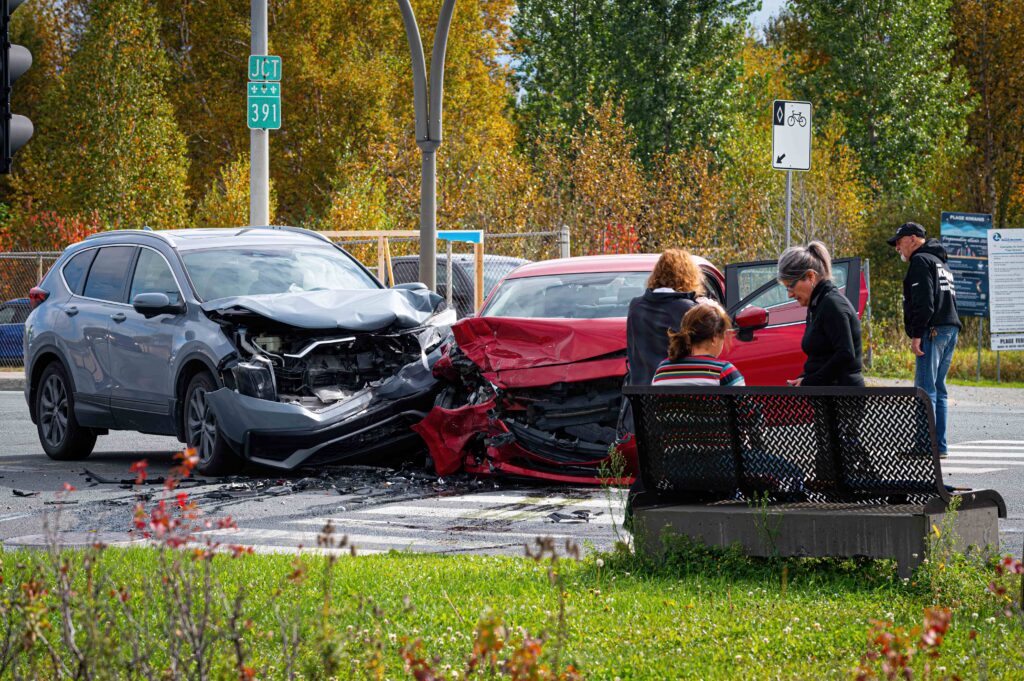
Intersections create split-second decisions. Drivers accelerate to beat yellow lights. Others inch forward to turn left. When two vehicles collide, both drivers often believe they acted correctly. Without independent witnesses, the case may come down to which version sounds more believable, unless evidence tips the scale.
The absence of neutral witnesses
Many intersection crashes happen in the early morning or late at night. Fewer cars on the road means fewer witnesses. Even during busy hours, other drivers may focus on their own commute and leave before police arrive. Without a third party to confirm who had the right-of-way, the investigation relies heavily on physical proof.
Conflicting driver statements
Police officers usually separate drivers and record their statements. One person may claim, “I had the green light.” The other may say the same thing. Officers must then evaluate consistency, demeanor, and physical evidence. Small differences in wording can affect how the report reads.
Insurance companies exploiting uncertainty
Insurance carriers look for gaps. When facts appear unclear, adjusters may argue that liability remains uncertain. That argument often leads to reduced settlement offers or outright denials. Clear, documented evidence forces insurers to confront the facts rather than rely on confusion.
What evidence can prove fault when there are no witnesses?
Physical and digital evidence often speaks louder than personal accounts. A thorough investigation gathers multiple sources so the overall picture becomes clear.
Police report analysis and officer observations
An officer’s report may include diagrams, measurements, and notes about debris location. Officers also record statements about traffic signals and driver behavior. If one driver admitted to looking down at a phone, that detail can carry weight. While a police report doesn’t decide the case by itself, it often shapes early negotiations.
Traffic camera and surveillance footage
Richmond intersections sometimes include traffic cameras. Nearby businesses may also have surveillance systems pointed toward the street. Quick action matters, because some footage gets erased within days. A lawyer can send preservation letters to prevent deletion.
Video evidence can show which vehicle entered the intersection first, the color of the traffic light, or whether a driver sped through a red light.
Vehicle damage patterns and physics
The location and severity of damage often reveal who struck whom. For example, front-end damage to one vehicle and side damage to another may suggest that one driver failed to yield during a left turn. The angle of impact, crush depth, and airbag deployment timing all provide clues.
Electronic data recorders (black boxes)
Modern vehicles contain event data recorders. These devices may capture speed, braking, throttle position, and seatbelt use seconds before impact. That data can show whether a driver attempted to stop or accelerated into the intersection.
Skid marks and road evidence
Tire marks measure braking distance. Longer skid marks may indicate higher speed. The absence of skid marks might suggest a driver didn’t attempt to stop. Debris patterns can also identify the point of impact, which often determines right-of-way issues.
Cell phone records and distraction evidence
Phone records may show whether a driver sent or received a text around the time of the crash. Combined with other evidence, that information can support a claim that distraction caused the collision.
How do Virginia traffic laws determine fault at intersections?
Virginia law sets clear rules for who must yield and when. Violating those rules often forms the foundation of a liability claim.
Right-of-way rules at controlled intersections
Drivers approaching a green light generally have the right-of-way. However, drivers turning left must yield to oncoming traffic, even with a green light, unless a green arrow permits the turn.
Stop sign and traffic signal violations
Running a red light or ignoring a stop sign breaks traffic law. If a driver enters the intersection against a signal, that act strongly supports liability. Police citations often document these violations.
Left turn liability under Virginia Code § 46.2-846
Virginia Code § 46.2-846 requires drivers turning left to yield to vehicles approaching from the opposite direction that are close enough to pose a hazard. Many intersection crashes occur because a driver misjudges distance or speed and turns anyway.
Failure to yield laws
Drivers entering a roadway from a private drive or side street must yield to traffic already in the intersection. Failure to do so often results in T-bone collisions.
Speed limits and excessive speed
Speed affects stopping distance. A driver who exceeds the limit may not stop in time for a changing light. Event data recorders and skid marks often reveal speeding.
Can traffic violations prove liability in he said/she said cases?
Traffic violations frequently provide strong support, especially when driver stories conflict.
Virginia’s presumption of negligence for code violations
When a driver violates a safety statute designed to protect others, courts often treat that violation as evidence of negligence. For example, running a red light may create a presumption that the driver acted negligently.
How citations impact your case
If the officer issued a ticket to the other driver, that citation can support your claim. Insurance carriers often review citation records when evaluating liability. A conviction in traffic court can further strengthen your case.
Proving violations without police citations
Sometimes, officers don’t issue tickets at the scene. Lack of a citation doesn’t end your claim. Video footage, black box data, and witness statements can still show that a driver violated traffic law.
What role do accident reconstruction experts play?
When physical evidence requires technical interpretation, accident reconstruction can provide clarity.
How reconstructionists analyze physical evidence
Reconstruction professionals review vehicle damage, roadway measurements, and electronic data. They apply physics principles to determine speed, angle, and sequence of events.
Computer simulations and diagrams
Software programs recreate collisions using data inputs. These visual models can show how the crash unfolded, helping jurors and adjusters understand the mechanics.
Expert testimony in Virginia courts
Courts allow qualified reconstruction professionals to explain their findings. Clear testimony can counter inaccurate driver statements.
When expert analysis is worth the investment
Not every case requires reconstruction. However, serious injury cases with disputed liability often benefit from detailed analysis. When medical bills rise into the tens of thousands, investing in strong proof often makes sense.
What should you do immediately after an intersection accident?
The steps you take in the minutes and days after a crash can shape both your recovery and your injury claim. Clear documentation and prompt medical care create a strong foundation.
Document everything at the scene
If you’re physically able, start gathering information right away. Take photos of the vehicles from multiple angles. Capture traffic lights, stop signs, skid marks, debris, and any visible injuries. Photograph the intersection layout, including lane markings and crosswalks.
Exchange contact and insurance information with the other driver. If witnesses stop, ask for their names and phone numbers. Small details, like weather conditions or heavy traffic, may later help explain how the crash occurred.
Busque atención médica inmediatamente
Even if you feel okay, get checked by a medical professional as soon as possible. Some injuries, such as concussions or internal bleeding, don’t show symptoms right away.
In Richmond, you can seek treatment at VCU Medical Center, Bon Secours St. Mary’s Hospital, or Chippenham Hospital. Several Patient First urgent care centers in the area also evaluate accident injuries.
Prompt care protects your health and creates medical records that connect your injuries to the crash.
Avoid giving recorded statements
Insurance adjusters may call within days of the collision. You have no obligation to provide a recorded statement immediately. Politely decline until you receive legal guidance.
Preserve electronic evidence
Save dashcam footage, text messages, and app data that may show your location or activity at the time of the crash. Avoid deleting anything from your phone.
Contact an attorney before settlement discussions
Early legal advice helps protect your rights and prevents missteps during negotiations with insurance companies.
How our firm can help

At Allen & Allen, we have represented injured Virginians for more than a century. Since 1910, our firm has operated under core values of integrity, respect, compassion, and trust. Those principles guide every case we handle.
We commit to more than simply providing you with legal representation. We commit to making your fight our fight, ensuring you are treated fairly by the insurance companies, and obtaining justice on your behalf. That’s what we mean when we say, “I am an Allen.”
Immediate investigation and evidence preservation
Our team moves quickly to gather police reports, request camera footage, and send preservation letters. Early action prevents loss of key evidence.
Working with accident reconstruction experts
When needed, we collaborate with reconstruction professionals who analyze physical and digital data. Their findings often clarify disputed liability.
Handling insurance company tactics
We manage communications with adjusters, respond to blame-shifting arguments, and present evidence in a clear, organized manner.
Building your case with multiple evidence sources
Strong cases rely on layered proof. Including registros médicos, crash data, photographs, and legal analysis. We assemble these pieces into a consistent narrative supported by facts.
Protecting you from contributory negligence defenses
Because Virginia’s fault rule sets a high bar, we prepare each case with detailed documentation and careful review of traffic laws.
Frequently asked questions about liability in intersection accidents
What happens if the other driver lied to the police about what happened?
Police officers document statements, but they also examine physical evidence. If the other driver gave inaccurate information, additional proof such as video footage or black box data can correct the record. Your attorney can gather that evidence and present it clearly.
How long do I have to file a lawsuit for my intersection accident in Virginia?
Virginia generally allows two years from the date of the crash to file a personal injury lawsuit. Missing that deadline may prevent you from pursuing damages. Speaking with a lawyer soon after the crash helps protect your timeline.
Will my case be stronger if the other driver got a ticket?
A citation often strengthens a claim because it documents a traffic violation. However, lack of a ticket doesn’t prevent recovery. Other forms of evidence may still establish liability.
Can dashcam footage from my vehicle be used against me?
Dashcam footage can help or hurt depending on what it shows. Reviewing footage with your attorney before sharing it with insurance companies allows for proper evaluation.
What if both drivers claim they had the green light?
When both drivers claim the green light, investigators look to physical evidence, signal timing data, and camera footage. Electronic data and witness accounts often clarify which vehicle entered lawfully.
Contact our experienced car accident attorneys in VA now
Intersection cases move quickly. Camera footage disappears. Witnesses relocate. Insurance companies build their defenses early. Taking prompt action protects your claim and preserves evidence.
Allen & Allen brings more than 100 years of service to Virginia families. Our commitment to integrity, respect, compassion, and trust shapes how we treat every client. We approach each case with care, preparation, and dedication to fair treatment.
If a Richmond intersection crash left you injured and another driver now disputes fault, reach out for a free consultation. A free consultation with our team can help you understand your options and decide your next steps with confidence.
Programe una consulta gratuita